Blog
Introduction
PRN pharmacist pay works differently than traditional staff salaries—and understanding the differences can help you make smarter career decisions. Whether you're considering your first PRN shift or building a full-time per diem career, knowing what to expect (and how to maximize your earnings) is essential.
The short answer: PRN pharmacists typically earn $55-$85+ per hour depending on setting, location, and shift type. That's often 20-40% higher than the hourly equivalent of a staff pharmacist salary. But there's more to the picture than hourly rates.
This guide breaks down PRN pharmacist compensation across settings, shifts, and geographies—plus the trade-offs you should consider.
Why PRN Rates Differ from Staff Salaries
Staff pharmacists receive a salary plus benefits: health insurance, paid time off, retirement contributions, and job security. Employers factor these benefits into total compensation, typically adding 25-35% on top of base salary.
PRN pharmacists trade those benefits for higher hourly rates and flexibility. Facilities pay more per hour because they're not providing benefits and because PRN staff fill urgent, often inconvenient shifts.
The math often works in the PRN pharmacist's favor—especially for those who secure their own benefits or work enough hours to offset the trade-off.
National Average PRN Pharmacist Rates
As of early 2026, PRN pharmacist hourly rates generally fall within these ranges:
Experience Level | Typical Hourly Range |
|---|---|
Entry-level (0-2 years) | $55-$65/hour |
Mid-career (3-7 years) | $60-$75/hour |
Experienced (8+ years) | $65-$85/hour |
Specialist credentials | $70-$90+/hour |
These are baseline figures. Actual rates vary significantly based on setting, shift type, and location—which we'll explore below.
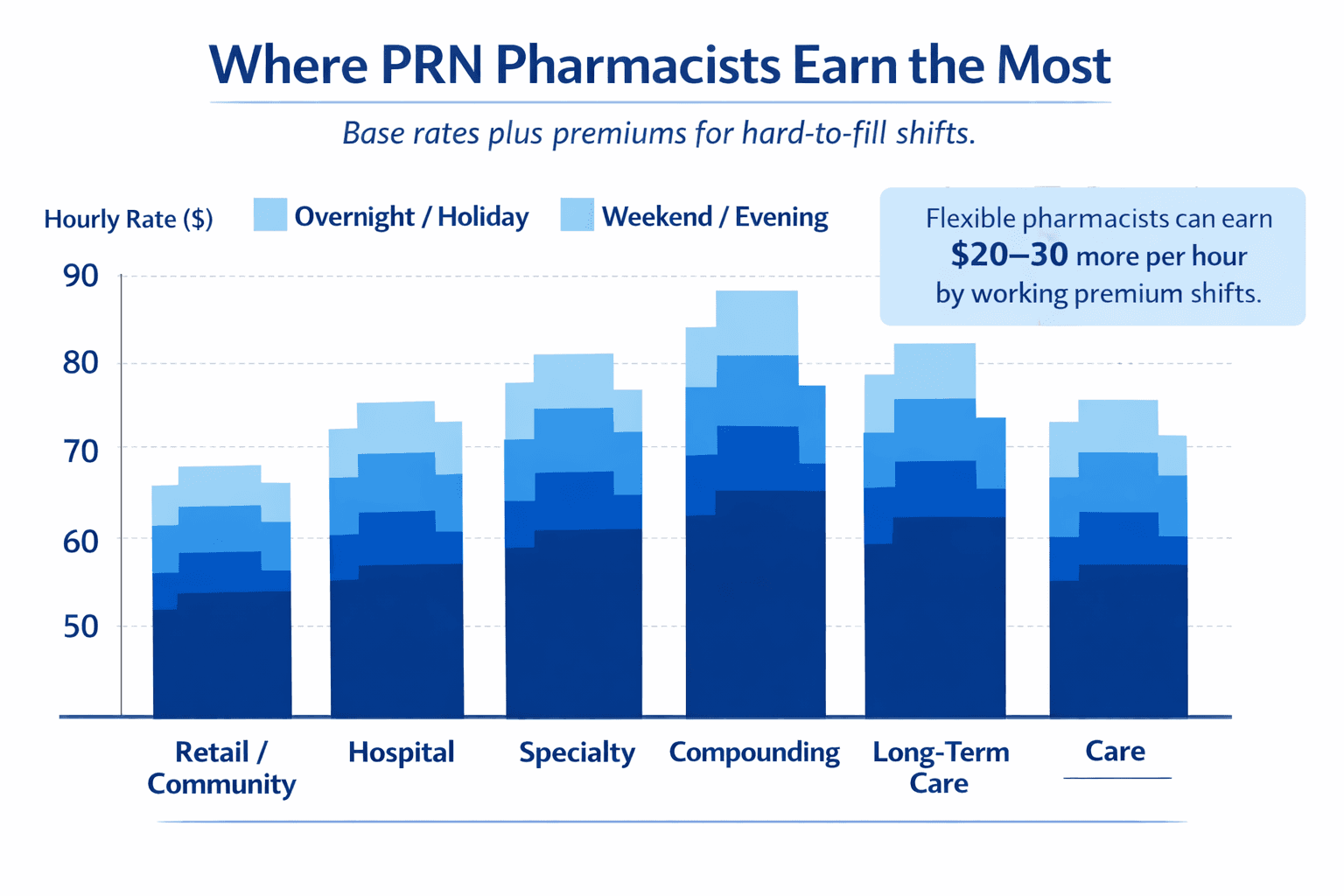
PRN Rates by Pharmacy Setting
Below are the PRN rates based on the different settings a pharmacist can expect to work.
Retail/Community Pharmacy
Standard shifts: $55-$70/hour
Weekend/holiday shifts: $65-$80/hour
Last-minute/emergency fills: $70-$85/hour
Retail PRN work is the most widely available. Chain pharmacies (CVS, Walgreens, Walmart) and independent pharmacies consistently need coverage for sick calls, vacations, and variable demand.
Hospital/Health-System Pharmacy
Standard shifts: $60-$75/hour
Overnight shifts: $68-$82/hour
Weekend/holiday shifts: $70-$85/hour
Hospital PRN positions often require more clinical experience and may involve IV admixture, clinical rounding, or specialty services. Rates reflect these additional requirements.
Specialty Pharmacy
Standard shifts: $65-$80/hour
Complex specialty (oncology, transplant): $72-$88/hour
Specialty pharmacy PRN positions require specific training and certifications. These roles are less common but command premium rates.
Compounding Pharmacy
Standard shifts: $60-$75/hour
Sterile compounding: $65-$80/hour
Compounding pharmacies value precision and specialized training. IV compounding certification typically increases rates.
Long-Term Care
Standard shifts: $58-$70/hour
Consultant roles: $65-$80/hour
Long-term care PRN positions may involve both dispensing and consultant pharmacist responsibilities.
Shift Type Premiums
Not all hours are created equal. Facilities pay premiums for shifts that are harder to fill:
Shift Type | Typical Premium |
|---|---|
Weekday daytime | Base rate |
Evening (after 6pm) | +$3-$8/hour |
Overnight | +$8-$15/hour |
Weekend | +$5-$12/hour |
Holiday | +$15-$25/hour |
Last-minute (< 24 hours notice) | +$10-$20/hour |
A pharmacist earning $60/hour on weekday daytime shifts might earn $75-$85/hour for a last-minute Saturday overnight—a significant boost for flexibility.
Geographic Variations
Location dramatically affects PRN pharmacist pay. The highest-paying markets typically combine high cost of living, strong demand, and competitive healthcare sectors.
Top-Paying States (2026)
California: $65-$90/hour
New York: $60-$80/hour
Massachusetts: $58-$78/hour
Washington: $58-$75/hour
New Jersey: $55-$75/hour
Connecticut: $55-$75/hour
Alaska: $60-$80/hour
Hawaii: $58-$78/hour
Oregon: $55-$72/hour
Maryland: $55-$72/hour
Premium Metro Areas
San Francisco Bay Area: $70-$90+/hour
New York City: $65-$85/hour
Los Angeles: $65-$85/hour
Seattle: $60-$78/hour
Boston: $60-$78/hour
San Diego: $62-$80/hour
Moderate-Rate Markets
Most of the country falls in the $50-$65/hour range for standard PRN shifts, with premiums for difficult-to-fill shifts and specialty roles.
The Benefits Trade-Off
Higher hourly rates come with trade-offs. Here's what to consider:
What You Gain with PRN Work
Higher effective hourly rate (often 20-40% above staff equivalent)
Schedule flexibility (work when you want)
No employer politics or mandatory meetings
Variety (different settings, teams, challenges)
Tax deductions (if working as 1099 contractor)
What You Give Up
Health insurance (must secure independently)
Paid time off (no pay when not working)
Retirement contributions (no employer 401k match)
Job security (shift availability varies)
Consistent income (earnings fluctuate)
Doing the Math
Consider a staff pharmacist earning $130,000/year with benefits worth $30,000 (health insurance, PTO, retirement). That's $160,000 total compensation for ~2,080 hours = ~$77/hour total compensation.
A PRN pharmacist averaging $65/hour for 40 hours/week (2,080 hours/year) earns $135,200. After paying for health insurance ($6,000/year) and setting aside 15% for self-employment taxes ($20,000), net take-home is roughly $109,000.
However, a PRN pharmacist averaging $75/hour (achievable with weekend/night shifts) earns $156,000 gross. That is potentially exceeding the staff position even after benefits and taxes.
The math depends on your rates, hours, and personal situation. For many pharmacists, PRN work offers comparable or better compensation with significantly more flexibility.
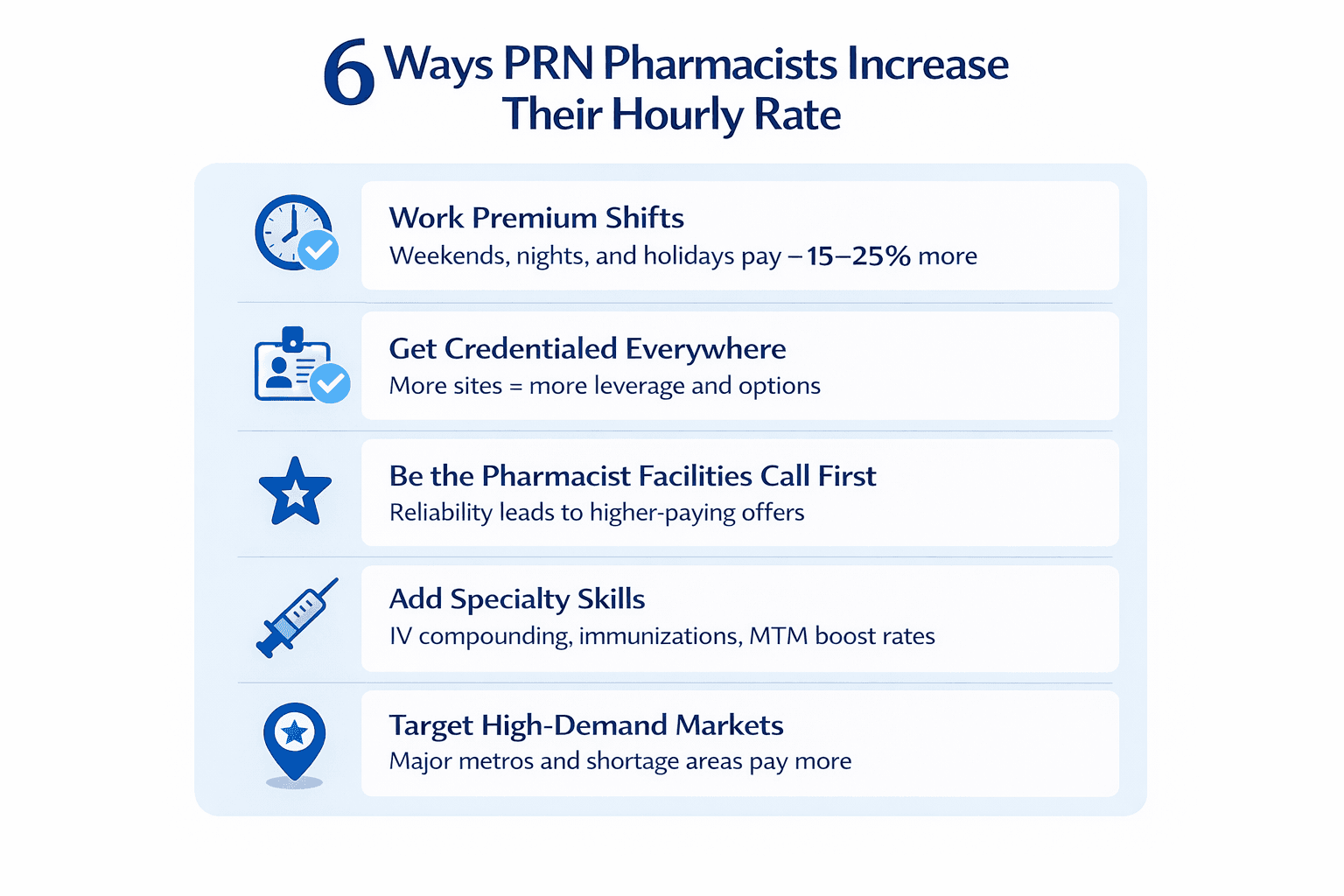
How to Maximize Your PRN Earnings
Be Available for Premium Shifts
Weekends, holidays, and overnights pay significantly more. Building your schedule around these shifts can increase average hourly rate by 15-25%.
Maintain Multiple Credentialing Relationships
Don't rely on a single facility or platform. Being credentialed at multiple locations gives you more shift options and leverage.
Build a Reputation for Reliability
Facilities pay premium rates for pharmacists they trust. Show up on time, document thoroughly, and handle unexpected situations professionally. Word spreads quickly.
Develop Specialty Skills
IV compounding certification, immunization credentials, MTM training, and specialty pharmacy experience all command higher rates.
Work in High-Demand Markets
If you're mobile, consider targeting markets with strong demand and high rates. California, New York, and major metros consistently offer premium compensation.
Use Platforms That Maximize Your Take-Home
Traditional staffing agencies take 25-40% of what facilities pay. Platforms like ShiftRx connect you directly with facilities, meaning more of the rate goes to you.
Track and Optimize Your Tax Situation
If you're working as a 1099 contractor, deductions for mileage, continuing education, supplies, and home office can significantly reduce your tax burden. Work with a tax professional familiar with healthcare contractor situations.
Frequently Asked Questions
Q: Can I support myself full-time on PRN work? A: Absolutely. Many pharmacists build full-time careers entirely from PRN shifts. The key is consistent availability, multiple credentialing relationships, and financial planning for variable income.
Q: How does PRN work affect my license? A: PRN work doesn't affect your license status. You're still a licensed pharmacist regardless of employment arrangement. Just ensure you maintain continuing education requirements.
Q: What about malpractice insurance? A: Most facilities cover you under their malpractice policy while working their shifts. Some pharmacists also carry personal professional liability insurance (~$200-$500/year) for additional protection.
Q: How do I find PRN shifts? A: Platforms like ShiftRx connect pharmacists with available shifts across retail, hospital, and specialty settings. You can also contact facilities directly or work through traditional staffing agencies.
Conclusion
PRN pharmacist compensation offers compelling advantages: higher hourly rates, schedule flexibility, and career autonomy. While the benefits trade-off requires planning, many pharmacists find that PRN work provides better overall compensation and quality of life than traditional staff positions.
The key is understanding your market, targeting premium shifts, and building relationships that lead to consistent opportunities.
Ready to explore PRN pharmacy opportunities? ShiftRx connects pharmacists with flexible shifts across all 50 states—retail, hospital, and specialty settings. Set your availability, browse opportunities, and start earning on your terms.