Blog
Introduction
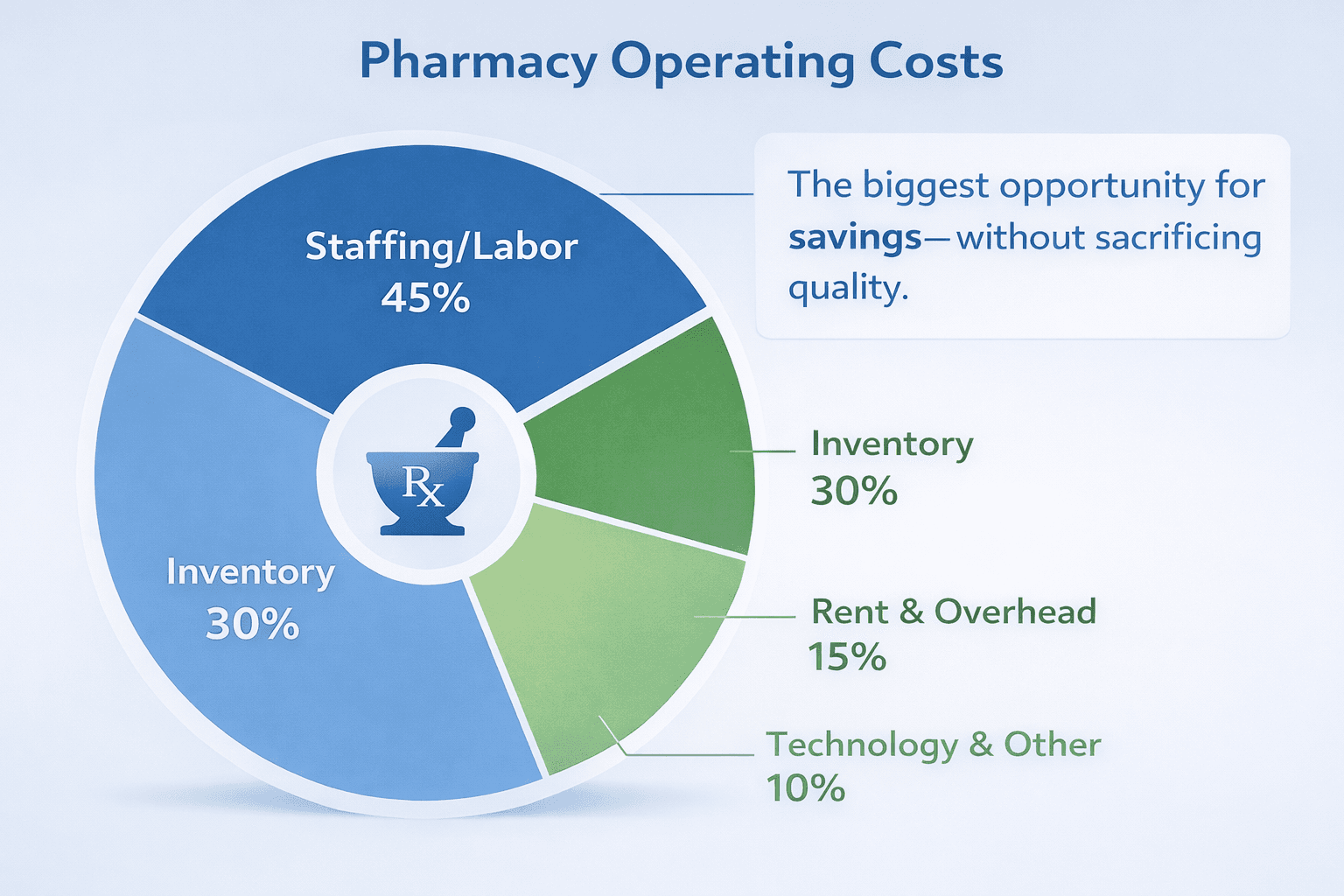
Pharmacy labor costs are eating up your budget. For most pharmacy operations, staffing expenses represent 40-50% of total operating costs—often the single largest line item on the P&L statement. As a pharmacy manager or director, you're under constant pressure to do more with less, maintain service quality, and keep patients safe while controlling expenses.
The good news? You don't have to choose between affordability and excellence. Strategic staffing decisions can significantly reduce your pharmacy labor costs while actually improving operations and employee satisfaction.
Let's explore five proven strategies to optimize your staffing approach and maximize your budget.
1. Leverage PRN and Flexible Staffing Instead of Over-Relying on Full-Time Positions
The traditional staffing model—building a team of 100% full-time employees—made sense in a predictable world. But modern pharmacy operations are anything but predictable. Patient volumes fluctuate seasonally, staffing needs vary by day of week, and unexpected absences create chaos.
Many pharmacies over-staff with full-time employees to handle peak hours, then pay idle wages during slower periods. This is expensive inefficiency.
The Solution: Implement a strategic mix of full-time core staff and PRN (as-needed) pharmacists and technicians to cover fluctuating demand.
PRN staffing provides flexibility without the overhead of full-time benefits. You pay only for hours worked, eliminating costs for:
Health insurance premiums
Paid time off accrual
Retirement contributions
Payroll taxes on unused capacity
A pharmacy that maintains a lean full-time core (60-70% of your baseline needs) and uses PRN staff to fill peaks can reduce overall staffing costs by 15-25%. More importantly, you eliminate the burnout that comes from chronic overstaffing or understaffing—your full-time team stays fresh and engaged.
2. Cut Pharmacy Agency Fees with Direct Staffing Platforms
Here's where most pharmacies hemorrhage money: pharmacy agency fees.
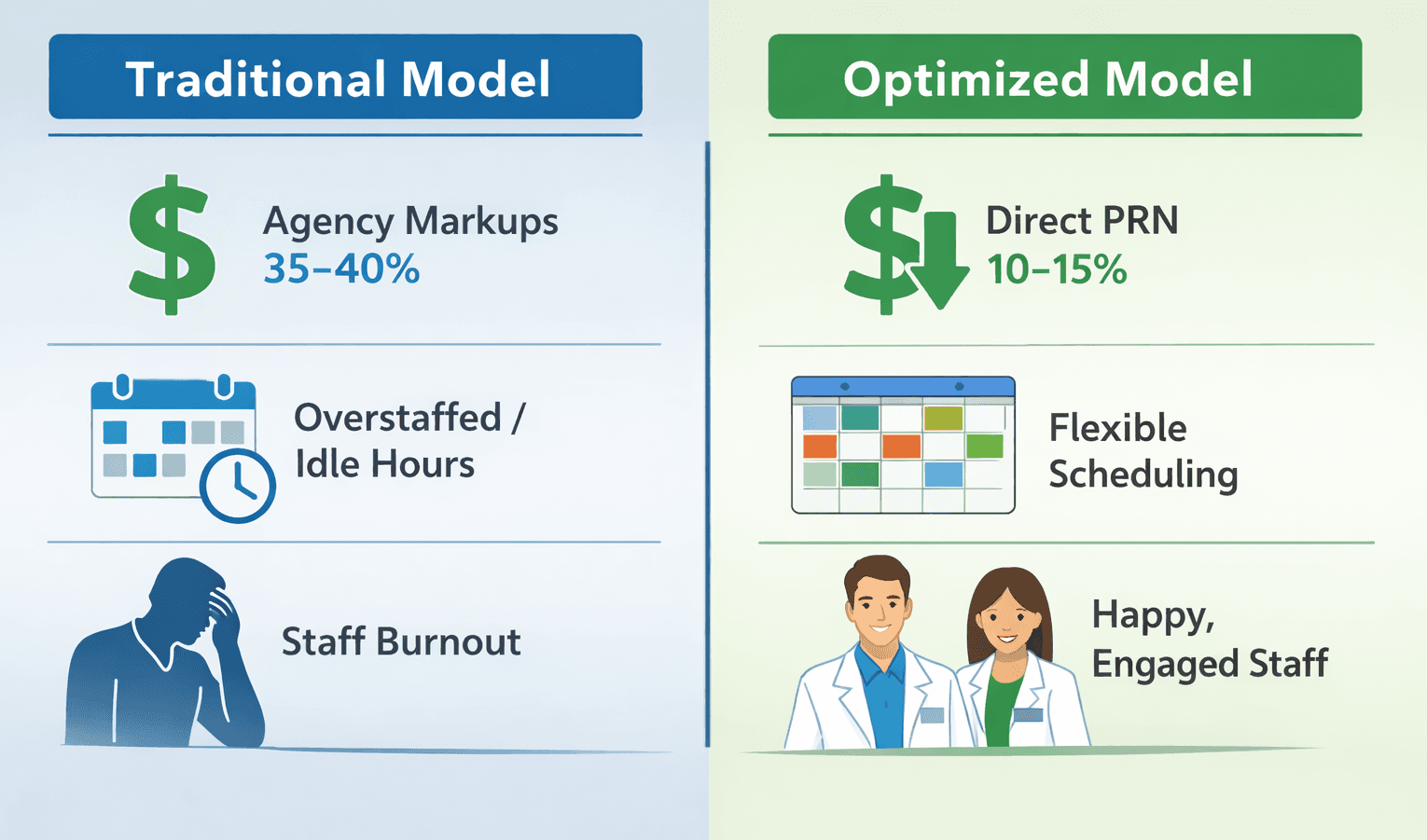
Traditional staffing agencies take 25-40% markups on pharmacist and technician wages. If you're paying $50/hour to an agency for a technician, that tech is earning roughly $30-37/hour—and the agency pockets the difference.
For a 500-hour monthly PRN commitment, that's $7,500-$10,000 in agency fees that don't benefit your patients or your staff.
The Modern Alternative: Direct staffing platforms like ShiftRx eliminate the agency middleman entirely.
ShiftRx connects pharmacies directly with vetted, qualified PRN professionals, reducing costs to 10-15% of hourly wages—instead of 25-40%. This means:
You save significant money on labor costs
PRN staff earn more (increasing attraction and retention of quality talent)
Payment is transparent and predictable
You maintain direct relationships with your staffing pool
A pharmacy spending $50,000 monthly on agency staffing could reduce that to $35,000-$40,000 using direct PRN platforms—$120,000-$180,000 in annual savings. That's the difference between breaking even and investing in patient care.
3. Optimize Scheduling with Data-Driven Demand Forecasting
Inefficient scheduling is another silent cost killer. Many pharmacies create schedules based on habit ("We've always had three technicians on Tuesday") rather than data.
Real demand varies:
Prescription volume by day of week and time of day
Seasonal fluctuations (flu season, insurance changes in January)
Local events or holidays affecting patient traffic
Staff absences or training requirements
The Strategy: Implement demand forecasting using your pharmacy management system data.
Analyze 12 months of historical data to identify staffing patterns. Use this to build dynamic schedules that match actual demand. Most pharmacies discover they're over-staffed during slow periods and under-staffed during predictable peaks—but the fix is data-driven, not reactive.
Benefits:
Reduce unnecessary payroll hours by 5-10%
Improve employee scheduling satisfaction (employees want predictable hours)
Maintain service quality during peak demand
Enable better PRN planning and coordination
4. Invest in Retention to Prevent Costly Turnover
Turnover is expensive. The true cost of losing a pharmacist includes:
Recruitment and hiring costs: $2,000-$5,000
Training time: 80-120 hours at fully-loaded cost
Lost productivity during ramp-up: 4-8 weeks
Institutional knowledge loss
Impact on remaining team morale and burnout
Total cost of turnover per pharmacist: $15,000-$30,000
Yet many pharmacies slash wages or cut quality-of-life benefits to save money—directly increasing turnover risk.
The Better Investment: Use savings from the strategies above to improve retention.
Consider redirecting 20-30% of savings from reduced agency fees toward:
Modest wage increases or performance bonuses
Professional development and certification support
Flexible scheduling options
Better equipment or working conditions
Recognition programs
A pharmacist earning $55/hour with benefits costs roughly $80,000 annually. If improved conditions reduce turnover from 25% annually to 15%, you've prevented one departure per year—saving $20,000+ in replacement costs while boosting morale.
The math is compelling: spend $3,000 more on retention to save $20,000 in turnover costs.
5. Cross-Train Staff and Maximize Pharmacy Technician Utilization
Many pharmacies under-utilize pharmacy technicians, assigning them to routine tasks while pharmacists handle work technicians could do. This is backwards economics.
Optimize your staffing mix:
A licensed pharmacy technician costs $25-$35/hour (fully loaded). A pharmacist costs $55-$75/hour. When a pharmacist spends time on tasks a technician could handle, you're paying premium wages for routine work.
Strategic cross-training:
Train technicians to handle insurance verification, prior authorizations, and billing
Develop medication therapy management (MTM) technician roles
Create specialty training (oncology, IV compounding, immunizations)
Build internal advancement paths so top technicians stay and grow
This allows pharmacists to focus on clinical work where they add real value—medication reviews, patient counseling, immunizations, and chronic disease management.
The financial impact:
Reduce pharmacist hours by 5-10% through better task distribution
Increase technician productivity and job satisfaction
Improve patient safety through specialization
Create career paths that improve retention
A pharmacy that shifts just 10% of administrative work from pharmacists to cross-trained technicians saves $8,000-$12,000 annually while improving service quality.
Calculating Your Potential Savings
Let's quantify this for a typical 24-hour retail pharmacy:
Current State (Traditional Model):
Full-time staff: 8 FTE pharmacists + 12 FTE technicians
PRN coverage (via agency): 200 hours/month at $50/hour
Agency fee markup: 35%
Monthly staffing cost:
Full-time payroll: $65,000
Agency PRN: $10,000 + $3,500 agency fee = $13,500
Total: $78,500/month ($942,000/year)
Optimized State (ShiftRx Model):
Full-time staff: 6 FTE pharmacists + 10 FTE technicians (more efficient scheduling)
Direct PRN via ShiftRx: 200 hours/month at $50/hour with 12% fee
Better retention reducing turnover costs
Monthly staffing cost:
Full-time payroll: $52,000
Direct PRN via ShiftRx: $10,000 + $1,200 platform fee = $11,200
Reduced turnover expenses: savings of ~$2,000/month
Total: $65,200/month ($782,400/year)
Annual savings: $159,600 (17% reduction)
These numbers reflect real-world implementations. Your specific savings will vary, but most pharmacies see 10-20% reductions by combining these strategies.
Conclusion: Quality Doesn't Have to Cost More

Reducing pharmacy staffing costs isn't about cutting corners or compromising patient care. It's about working smarter—eliminating waste, aligning staffing with actual demand, and reinvesting savings into retention and quality.
The biggest opportunity for most pharmacies is eliminating agency middleman fees. Platforms like ShiftRx give you access to quality PRN professionals at 50-60% of traditional agency costs, while PRN professionals earn more. Everyone wins.
Ready to reduce your pharmacy labor costs? Start by auditing your current agency spending and scheduling efficiency. Even a 10% improvement delivers six-figure annual savings for most operations.