Blog
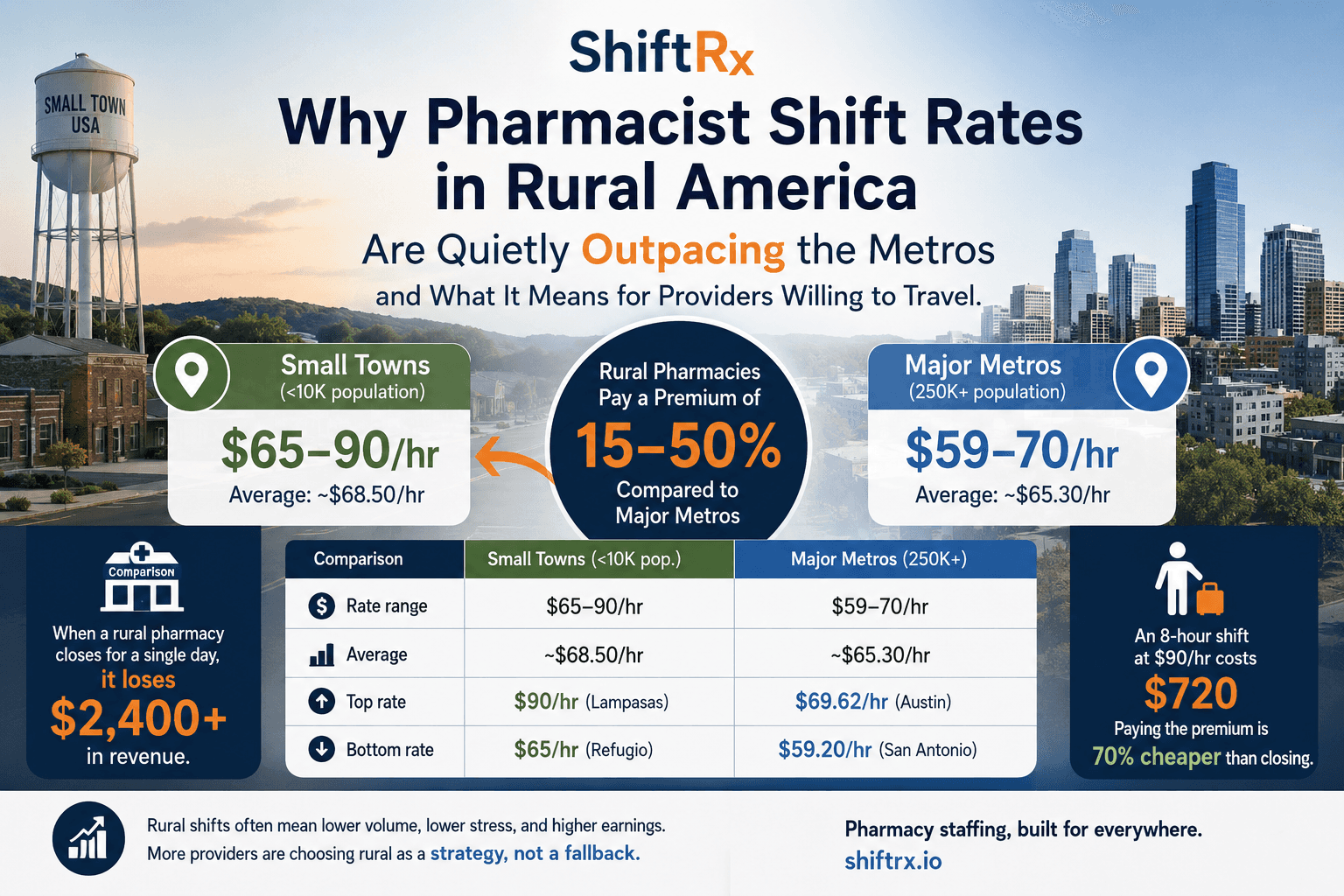
Why pharmacist shift rates in rural America are quietly outpacing the metros, and what it means for providers willing to travel.
Everyone assumes the money is in the city. More volume, more pharmacies, more competition for talent. Metro rates should be higher, right?
We looked at our own data. They’re not.
What We Found
ShiftRx connects pharmacies with pharmacists and technicians for PRN shift coverage. We analyzed completed pharmacist shifts across our platform and compared rates in small towns (population under 10,000) against major metros (population 250,000+) within the same state.
The results weren’t subtle.
In Texas, our deepest dataset, small-town pharmacies pay $70–90/hr for pharmacist coverage. Major metros like Houston, Dallas, and San Antonio pay $59–67/hr.
That’s a premium of 15–50%, depending on the town.
Small Towns (<10K pop.) | Major Metros (250K+) | |
|---|---|---|
Rate range | $65–90/hr | $59–70/hr |
Average | ~$68.50/hr | ~$65.30/hr |
Top rate | $90/hr (Lampasas) | $69.62/hr (Austin) |
Bottom rate | $65/hr (Refugio) | $59.20/hr (San Antonio) |
These are completed shifts. Real pharmacists, real pharmacies, real hours worked.
Why Small Towns Pay More
It comes down to supply, not generosity.
There’s no local candidate pool. A pharmacy in Junction, Texas (population 2,500) can’t post on Indeed and expect 50 applicants. There might be three pharmacists within driving distance, and they all have jobs.
Staffing agencies won’t touch it. Traditional agencies need volume to justify the overhead. A single pharmacist placement in a town of 1,800 people doesn’t cover the recruiter’s commission. Rural pharmacies get skipped.
The alternative is closing. When you’re the only pharmacy in town and your pharmacist calls in sick, you don’t have a backup plan. You have a locked door and a community without medication access. At that point, $75/hr or $90/hr is the cost of staying open.
For context: a pharmacy that closes for a single day loses an estimated $2,400+ in revenue. An 8-hour shift at $90/hr costs $720. Paying the premium is 70% cheaper than closing.
What This Means for Providers
If you’re a pharmacist looking at PRN or per diem work, the highest-paying shifts aren’t in Manhattan or downtown LA. They’re in places like Lampasas, Glen Rose, and Three Rivers.
The trade-off is distance, not difficulty. Rural shifts are often lower volume, lower stress, and come with perks metro shifts don’t: housing stipends, multi-day bookings that reduce travel frequency, and communities that genuinely appreciate your presence.
A 2-hour drive for a $90/hr shift nets you roughly $240 more than taking a $65/hr shift down the street. Over a 3-day rural booking, that’s $720 in extra earnings for one round trip.
We’re seeing a growing number of providers on ShiftRx actively seeking rural shifts. Not as a fallback, but as a strategy.
What This Means for Rural Pharmacies
You’re already paying the premium. The question is whether you’re getting reliability in return.
Posting on a job board and hoping someone sees it isn’t a staffing strategy. Neither is calling the same three relief pharmacists and praying one is available.
Rural pharmacies deserve the same access to credentialed, vetted providers that metro pharmacies take for granted. The rate premium you’re paying should come with same-day matching, license verification, and a provider pool that’s actually willing to travel.
On our platform, one rural Texas pharmacy posted 133 shifts and filled them at $65/hr. Another posted 117 shifts at $70/hr. These aren’t one-off emergencies. These are pharmacies that built rural coverage into their operations.
The Bigger Picture
America has lost over 7,000 pharmacies since 2019 (Drug Channels, 2025). The closures aren’t evenly distributed. Rural communities are hit hardest. When a pharmacy closes in a town of 2,000 people, the nearest alternative might be 30, 50, or 100 miles away.
Staffing is at the center of this. A pharmacy that can’t reliably cover its shifts can’t reliably serve its community. And the traditional staffing model, built for metro volume and not rural access, has no answer for a town like Refugio, Texas.
The rate premium exists because the market is telling us something: rural pharmacies need coverage, they’re willing to pay for it, and nobody is delivering it at scale.
We think that’s worth solving.
ShiftRx is a pharmacy staffing platform connecting pharmacies with pharmacists and technicians for PRN, per diem, and permanent placement.
Data note: All rates cited are from completed pharmacist shifts on the ShiftRx platform as of April 2026. Rates reflect what pharmacies paid for coverage and vary by location, timing, and role. ShiftRx does not set rates. Pharmacies and providers negotiate directly on the platform.